Washington, D.C.: In a sweeping, day‑long policy unveiling dubbed the “Ignition” event, NASA has pivoted hard toward a tightly scheduled, mission‑driven roadmap to cement American leadership in space, anchored in President Donald J. Trump’s National Space Policy. On March 24, 2026, agency leaders announced a series of agency‑wide reforms, accelerated lunar architecture, a concrete path toward a permanent Moon base, preparations for nuclear‑powered interplanetary missions, and a re‑engineered transition plan for low Earth orbit (LEO) that together amount to the most ambitious re‑orientation of the U.S. space program in over a decade.
A Race Against the Clock

At the heart of the announcements is a blunt recognition of geopolitical urgency. NASA Administrator Jared Isaacman framed the “Ignition” agenda as a wartime‑style mobilization in response to intensifying great‑power competition in space. “NASA is committed to achieving the near‑impossible once again,” Isaacman told reporters, underscoring that the goal is to return humans to the Moon before the end of President Trump’s term, establish a sustained lunar base, and ensure that any perceived gap in U.S. leadership is closed “in months, not years.”
Isaacman went further, arguing that the current configuration of NASA—layered with legacy processes and fragmented priorities—must be streamlined around a single, unambiguous national imperative: American presence and dominance in cislunar and deep‑space operations. That imperative, he stressed, cannot be achieved without concentrating NASA’s scientific, engineering, and industrial resources, removing bureaucratic impediments, and empowering the workforce to operate at the pace of modern commercial space.
Ignition: Mission‑First, Workforce‑First

NASA Associate Administrator Amit Kshatriya expanded on this vision, declaring that the “Ignition” package is fundamentally about aligning every corner of the agency “around the mission.” The re‑orientation is three‑fold: on the Moon, in low Earth orbit, and in science.
On the lunar front, Kshatriya outlined a shift from bespoke, mission‑specific architectures to a phased, modular approach that builds capability “landing by landing,” in lockstep with U.S. and international industry. The emphasis is on incremental, repeatable progress rather than one‑off showpieces: each Artemis mission becomes a stepping stone toward a sustained surface presence.
In LEO, NASA is explicitly acknowledging where the commercial market is strong and where it is still fragile. The International Space Station (ISS), after more than two decades as the world’s premier orbital laboratory, will not be replaced by a single, monolithic government‑built successor. Instead, the agency is designing a transition strategy that leans on the ISS itself as an anchor for future commercial platforms, allowing those stations to mature in orbit before becoming independent.
In science, Kshatriya emphasized that “Ignition” is not just about hardware and logistics but about access. NASA is opening the lunar surface to researchers and students nationwide, creating a new pipeline of instruments, experiments, and payloads that will ride on commercial and government‑funded missions. The message is clear: space science must be democratized, not confined to a handful of elite institutions or legacy programs.
Tightened Artemis Cadence and the Moon‑Base Architecture
The announcements build upon recent revisions to the Artemis program, which now prescribes a more relentless operational tempo. NASA has standardized the configuration of the Space Launch System (SLS) rocket, added at least one extra mission in 2027, and committed to at least one surface landing every year thereafter. Artemis III, scheduled for 2027, will primarily test integrated systems and operational procedures in Earth orbit ahead of the Artemis IV lunar landing.
Beyond Artemis V, NASA is planning to integrate more commercially procured and reusable hardware into the lunar supply chain, targeting crewed surface landings roughly every six months, with the cadence ratcheting up as critical infrastructure and logistics networks mature. This move represents a quiet but decisive shift away from relying solely on expensive, government‑designed landers and toward a mixed‑fleet model that leverages private industry’s cost‑conscious engineering.
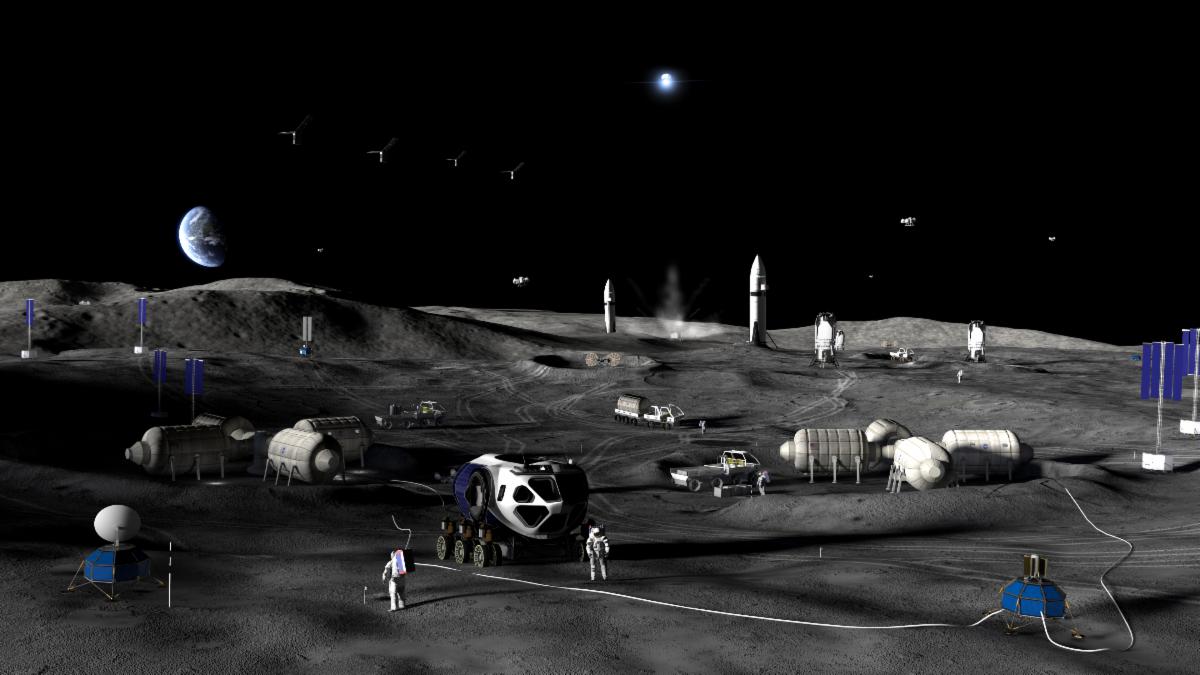
Central to the new strategy is a phased lunar‑base roadmap. NASA intends to pause the Gateway lunar space station in its current form and redirect focus toward infrastructure that enables sustained surface operations. This does not mean abandoning Gateway forever; instead, many existing modules and partner‑funded components will be repurposed or integrated into later‑stage architectures that directly support the Moon base.
The Base Itself Will Unfold in Three Stages:
Phase One – Build, Test, Learn: NASA will shift from infrequent, one‑off missions to a rhythm of repeatable, modular deliveries via the Commercial Lunar Payload Services (CLPS) program and the Lunar Terrain Vehicle (LTV) initiative. The aim is to increase the tempo of lunar activity, sending rovers, instruments, and technology demonstrations that sharpen capabilities in surface mobility, power generation, communications, navigation, and science. Radioisotope heater units and radioisotope thermoelectric generators will be key to surviving the long lunar night.
Phase Two – Early Semi‑Habitable Infrastructure: Drawing on lessons from early missions, NASA will move toward semi‑habitable structures and regular logistics services. This phase will support recurring astronaut operations on the surface and incorporate major international contributions, including Japan’s JAXA pressurized rover and other partner payloads, rovers, and transportation elements. The emphasis is on interoperability, common standards, and shared risk.
Phase Three – Long‑Duration Human Presence: As cargo‑capable human landing systems (HLS) come online, NASA will deliver heavier infrastructure needed for a continuous human foothold on the Moon. This transition marks the move from periodic expeditions to a permanent lunar base. Planned elements include the Italian Space Agency’s Multi‑purpose Habitats (MPH), the Canadian Space Agency’s Lunar Utility Vehicle, and opportunities for additional contributions in habitation, surface mobility, and logistics from both governments and private firms.
Additional Requests for Information (RFIs) and draft Requests for Proposals (RFPs) will be released in the coming days to harvest industry and partner input on how best to execute these phases without duplicating efforts or inflating costs.
Securing America’s Presence in Low Earth Orbit
Even as NASA accelerates its lunar ambitions, it is also redefining its role in low Earth orbit. The International Space Station, which has hosted more than 4,000 research investigations, 5,000 researchers, and visitors from 26 countries, cannot operate indefinitely. The facility required 37 shuttle flights, 160 spacewalks, two decades, and more than $100 billion to build.
Rather than risk a gap in U.S. human presence in orbit, NASA is introducing a new LEO strategy that preserves existing pathways while layering a phased, ISS‑anchored approach atop them. Under this alternative architecture, NASA would procure a government‑owned “Core Module” that attaches directly to the ISS. Subsequent commercial modules would be validated using the ISS’s power, communications, and life‑support systems, then detach into free‑flying stations once technical and operational maturity is demonstrated.
The same model applies to services: NASA intends to become one of many customers purchasing commercial LEO services, buying everything from crew transport to research time and specialized mission support. To stimulate the nascent orbital economy, the agency is expanding industry opportunities, including private astronaut missions, commander‑seat sales, joint missions, multiple module competitions, and prize‑based awards to spur innovation.
An industry RFI scheduled to open on March 25 is designed to solicit feedback on partnership structures, financing models, and risk‑mitigation frameworks, signalling that NASA wants industry to co‑design the LEO future rather than simply bid on it.
A Golden Age of Discovery
Alongside the operational and infrastructure shifts, NASA is doubling down on its identity as a science‑driven agency. The “Ignition” agenda positions the current era as a “Golden Age” of exploration and discovery, with flagship missions already reshaping our understanding of the universe.
The James Webb Space Telescope continues to peel back the veil on the early cosmos, while the Parker Solar Probe has flown directly through the Sun’s atmosphere, probing the dynamics of our nearest star in unprecedented detail. Earth‑science data from NASA satellites now underpin U.S. agriculture, disaster response, and climate planning, and the ISS is hosting cutting‑edge experiments in quantum science that could one day transform computing and communications.
Ahead lies an even more crowded manifest of discovery‑laden missions. The Nancy Grace Roman Space Telescope, launching as early as this fall, is poised to redefine our understanding of dark energy and set a new standard for management of large science missions. Dragonfly, a nuclear‑powered octocopter destined for Saturn’s moon Titan, will launch in 2028 and arrive in 2034 to explore one of the solar system’s most complex, organic‑rich environments.
In 2028, NASA will also launch and deliver ESA’s Rosalind Franklin rover to Mars, with NASA‑supplied mass‑spectrometer hardware for the Mars Organic Molecule Analyzer (MOMA). If successful, this instrument could perform the most advanced detection and analysis of organic matter ever conducted on Mars, potentially touching the edges of the question of whether life once existed on the Red Planet.
A new Earth‑science mission scheduled for next year will, for the first time, measure the internal dynamics of convective storms, improving the prediction of extreme weather events up to six hours before a storm forms—information that could save lives and reshape how insurers and governments prepare for disasters.
The Moon as a Science and Mars Testbed
NASA is also betting that the Moon itself will become a premier science platform. The agency is accelerating the cadence of CLPS missions, targeting up to 30 robotic landings starting in 2027. Payloads will range from rovers and hoppers to drones, with participation invited from industry, academia, and international partners. Early missions will include the VIPER rover, designed to probe the Moon’s polar regions for water ice, and the LuSEE‑Night experiment, which will study the lunar far‑side environment under cover of darkness.
A new RFI, issued on March 24, will call for payloads that can support NASA’s science and technology goals on additional 2027 and 2028 flights. These instruments will be developed by students and researchers across the United States, giving universities and startups a direct pipeline from campus labs to the lunar surface. The same RFI also solicits payloads for future Mars missions, including the Mars Telecom Network (MTN) and a nuclear technology‑demonstration mission that will test high‑power systems in the harsh Martian environment.
NASA additionally intends to partner with philanthropic and privately funded research organizations that share its objectives in space science, creating a layered ecosystem of public‑private discovery. The goal is to offload routine or commercially viable operations into industry hands while NASA focuses investment on the most transformational missions it alone can lead.
America’s Nuclear Pivot in Space
One of the most consequential announcements emerging from “Ignition” is NASA’s decision to push nuclear power and propulsion out of the laboratory and into deep space. For decades, nuclear electric propulsion has been studied and debated; under the new plan, it will be demonstrated in an operational spacecraft.
NASA intends to launch Space Reactor‑1 Freedom (SR‑1 Freedom), the first nuclear‑powered interplanetary spacecraft, to Mars before the end of 2028. This vehicle will use advanced nuclear electric propulsion to ferry mass efficiently through deep space, enabling missions far beyond the reach of solar arrays, including expeditions to the outer solar system.
Once SR‑1 Freedom reaches Mars, it will deploy the Skyfall payload, a suite of Ingenuity‑class helicopters designed to extend aerial reconnaissance of the Martian surface. More broadly, the mission will establish the first flight‑heritage nuclear hardware, set regulatory and launch‑safety precedents, and activate the industrial base for future fission‑powered systems across propulsion, surface power, and long‑duration missions.
NASA and the U.S. Department of Energy will jointly unlock the nuclear capabilities needed for sustained exploration beyond the Moon and eventual human journeys to Mars and the outer planets.
The Human Engine of Ignition
None of these ambitions, NASA officials concede, can succeed without a re‑invigorated workforce. The agency is now rebuilding its core competencies, converting thousands of contractor positions to civil‑service roles to restore the engineering, technical, and operational strengths expected of the world’s premier space organization.
NASA is expanding opportunities for interns and early‑career professionals and, in partnership with the U.S. Office of Personnel Management and NASA’s own “NASA Force” initiative, is creating new pathways for experienced industry talent to join the agency through term‑based appointments. The agency is also seeking to embed NASA employees directly within the most technologically advanced parts of the space industry, giving them first‑hand experience that can be fed back into government‑side thinking and decision‑making.
Subject‑matter experts will be embedded across the supply chain—at every major vendor, subcontractor, and critical‑path component—to challenge assumptions, accelerate production, and ensure that technical outcomes align with mission needs rather than simply contractual milestones.
The “Ignition” reforms will be rolled out over the coming months, with cross‑agency teams working to ensure that pivotal programs such as Artemis, ISS transition, and deep‑space science missions continue without disruption.
Through this package of initiatives, NASA is positioning itself not just as an engineering and science agency, but as the central orchestrator of a broader national‑security‑adjacent space enterprise. The message is clear: the United States intends to return to the Moon not as a one‑time victory lap, but as the first step in a sustained, multi‑planetary era of American leadership in space.