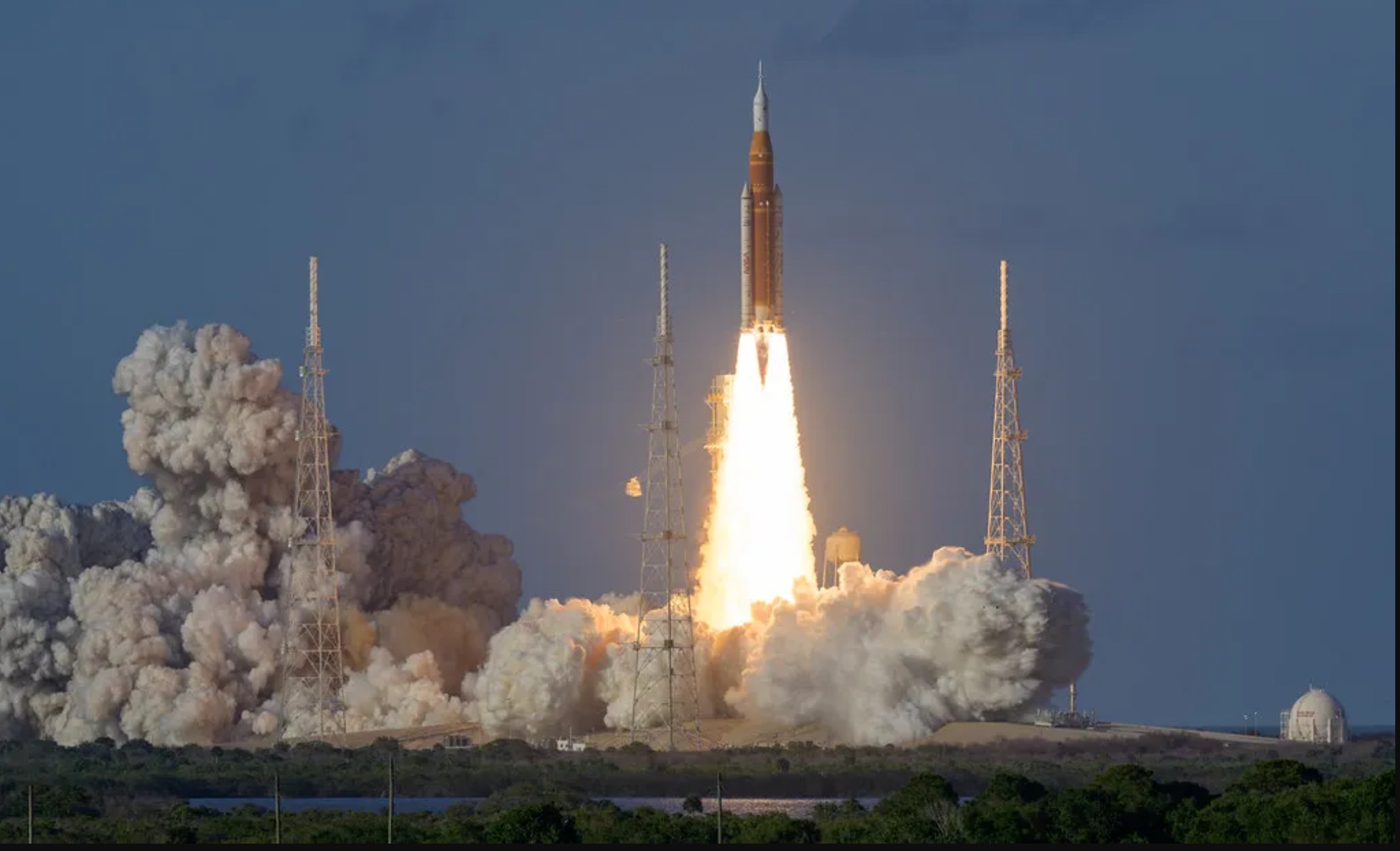
NASA’s Artemis II launch on April 1, 2026 marks the first time humans have left low Earth orbit since Apollo 17 in 1972, reigniting the deep‑space chapter of human exploration and setting the stage for a sustainable lunar presence. Carrying four astronauts aboard the Orion spacecraft atop the Space Launch System (SLS) rocket from Kennedy Space Center, Florida, the 10‑day mission is fundamentally a crewed test flight: it validates Orion’s life‑support systems, navigation, and operations in deep space while flying around the Moon on a free‑return trajectory, without landing.
A Historic Return to the Moon
Artemis II is the first crewed mission of NASA’s Artemis program and the first crewed lunar flyby in more than 50 years. The Apollo‑era halting of human Moon missions in 1972 left a gap in human deep‑space experience that Artemis II is designed to bridge with modern technology and international cooperation. Unlike Apollo, which focused on flags and footprints, Artemis is framed as a gateway to long‑term lunar science and eventual human missions to Mars, making Artemis II a critical “dress rehearsal” for that larger architecture.
The mission profile is a multi‑burn trajectory: the SLS first places Orion into a high Earth orbit, then performs additional trans‑lunar injection burns to send the capsule toward the Moon along a free‑return path. This trajectory means that, in the event of a propulsion failure near the Moon, gravity alone would slingshot the spacecraft back toward Earth, providing a built‑in safety margin. The crew will spend roughly a day in the vicinity of the Moon, at a distance that could make them the farthest humans have ever traveled from Earth, before beginning the return cruise.
Crew, spacecraft, and rocket
Artemis II is crewed by four astronauts: NASA’s Reid Wiseman (commander), Victor Glover (pilot), and Christina Koch (mission specialist), joined by Canadian Space Agency astronaut Jeremy Hansen (mission specialist). Wiseman, a veteran of the International Space Station, brings operational leadership and experience handling complex spacecraft systems; Glover, a U.S. Navy test pilot, will be the first Black pilot on a lunar mission; Koch, known for her 328‑day ISS mission that set a record for women, brings deep expertise in long‑duration human spaceflight; and Hansen, the first Canadian to fly around the Moon, symbolizes the broad international partnership underpinning Artemis.
The heart of the flight is the Orion spacecraft, named “Integrity” for Artemis II, which combines a conical crew module with a European‑built service module responsible for power, propulsion, and thermal control. Orion is designed to support crews for weeks at a time, with advanced radiation shielding, life‑support systems that can recycle air and water, and robust communications and navigation suites that will be tested in the harsh environment beyond low Earth orbit. The mission will also exercise Orion’s ability to manually pilot and conduct proximity operations, skills that will be essential for docking with future lunar space stations and for landing missions.
Beneath Orion stands the SLS Block 1 rocket, one of the most powerful launch vehicles ever built. Standing over 98 meters tall and weighing roughly 2.6 million kilograms at liftoff, SLS generates about 39 million newtons of thrust from its four liquid‑hydrogen‑fueled core‑stage engines and two solid rocket boosters. SLS first burned two minutes of solid‑booster thrust to clear the pad, then continued pushing Orion into orbit with the core stage, delivering the crew and spacecraft to the starting point for their trans‑lunar maneuvers. For Artemis II, this is the first crewed flight of SLS, making every second of its ascent a high‑stakes test of reliability and safety.
Mission objectives and scientific value
Although Artemis II does not land, it is far more than a symbolic “joyride.” The primary objectives are to verify the performance of Orion’s life‑support and environmental‑control systems with humans on board, to test communications and navigation across the vast distance to the Moon, and to evaluate the crew’s operational procedures during a multi‑day deep‑space voyage. Every system—cabin pressure, temperature control, waste management, and radiation protection—is scrutinized in ways that ground tests and simulations cannot fully replicate, because only the real environment can reveal subtle behaviors and failure modes.
The crew will also participate in human‑health and physiology studies, including experiments on sleep, motion, and the effects of increased radiation and microgravity on the body. One notable project is AVATAR (A Virtual Astronaut Tissue Analog Response), which uses organ‑on‑a‑chip devices to model how human tissues respond to space conditions, providing data that could shape countermeasures for longer missions to Mars. Geologically, the astronauts will make visual observations of the lunar surface as they whiz by their orbit, helping scientists refine candidate sites for the later Artemis III landing and for future lunar bases.
In parallel, engineers on Earth will monitor the Exploration Ground Systems—the launch pads, vehicle‑assembly buildings, and recovery infrastructure that support SLS and Orion—ensuring that the entire chain, from rollout on the crawler to splashdown in the ocean, behaves as predicted. This systems‑level validation is what turns Artemis II from a one‑off mission into a foundational step toward routine lunar access.
Why this moment matters
Artemis II arrives at a time when space exploration is no longer the preserve of a single superpower. The Canadian Space Agency’s role, alongside European partners who contributed to Orion’s service module, underscores the program’s explicitly international character. This contrasts with the Cold‑War‑era Apollo program, which was driven by U.S.–Soviet competition, and instead reflects a vision of sustained lunar and eventually Mars exploration built on shared costs, shared risk, and shared scientific benefit.
The mission also signals a shift in how humanity thinks about the Moon. Rather than a brief destination, the Moon is being framed as a “testbed” for technologies that will keep humans alive on Mars, from closed‑loop life‑support to advanced radiation‑shielding materials and in‑situ resource utilization concepts. Artemis II’s success is a prerequisite for Artemis III, currently targeting the first crewed lunar landing since 1972, and for the later deployment of the Lunar Gateway, a small space station in orbit around the Moon that will serve as a hub for regional exploration.
Public‑engagement and cultural dimensions are also significant. The spectacular night‑time liftoff from Kennedy Space Center has drawn millions of viewers online and in person, rekindling popular interest in space at a moment when private companies and national agencies are expanding their ambitions. The diversity of the Artemis II crew—spanning gender, race, and nationality—offers new role models for a generation that has grown up with digital distractions and climate anxiety, suggesting that big, collective challenges can still be met with courage and collaboration.
Looking ahead: from Artemis II to Mars
Artemis II is explicitly labeled a test flight, yet its legacy will likely stretch far beyond its 10‑day duration. Data from the mission will feed directly into the design of Artemis III and beyond, shaping everything from crew schedules and training protocols to the architecture of lunar landers and surface habitats. Engineers will scrutinize how Orion’s systems degrade over time, how much radiation the crew actually receives, and how effectively the team adapts to the isolation and confinement of deep space—all inputs for missions that could last months or years.
In the longer term, the Artemis framework is meant to progress from short‑term lunar sorties to a sustained presence on and around the Moon, then to crewed missions to Mars. Artemis II is the first time that humans ride on SLS and Orion in the deep‑space environment, and its success validates the hardware and operational philosophy that will underpin that entire progression. If Artemis II meets its goals, the next decade could see astronauts landing near the lunar south pole, operating rovers and habitats, and learning how to use lunar ice and regolith to produce water, oxygen, and even rocket fuel.
By the time those milestones arrive, Artemis II may be remembered as the quiet but decisive turning point: the moment when the Artemis program transitioned from test flights with no crew to real human voyages into the deep‑space frontier, once again setting the Moon in the crosshairs of human ambition.